FundraisingAdvisoryCouncil.com




SIMPLE STEPS TO ORGANIZE A
SUCCESSFUL CHARITY FUNDRAISING EVENT
By Jovia D'Souza
Charity fundraising events can be very challenging and overwhelming to put together even for those with experience in planning the same. The professional party planning may not always be an option in such events usually because of budget limits. But the good news here is that by following a few simple steps you can actually manage to organize an event that turns out great in the end. The steps below will not only increase your success rates, but will also give you a smoother experience planning the event.
Step 1 - Decide what the event will be
The type of event you choose can determine the numbers you attract and you therefore need to be very considerate when making a choice. There are so many charity fundraising ideas you can use to progress towards your expectations. Formal dinners, social gala events, race night and bingo are some of the popular events you can choose. The options are endless, you just need to think about the kind of people you are targeting for the fundraiser and select an event that will be appealing and exciting for them. If you are an organization with an impressive following already, then the usual charity walks, runs and golf tournaments can work for you.
Step 2 - Decide on location and time
A suitable venue is a must for any charity event. It should have all facilities necessary for the event and be easily accessible by all participants. It is best that you choose and book the venue early enough to avoid any setbacks and find out whether there are any requirements such as a license for the event. When choosing the time and date make sure that you leave enough time for you to get everything organized. It is a good idea to select the date with care so you do not end up clashing it with other big events that can rob your event of value in terms of attendance.
Step 3 - Create a budget and know how much you target to raise
The less you spend on a charity fundraising event the better and you should come up with ways of scaling back the budget. You can for instance, use volunteers instead of hiring help to plan the event. When creating the budget remember to include all important elements like catering, space and activities. You can source for donations to reduce planning costs. Still on money matters, it is very important that you know how much you target to raise from the event. Have a minimum amount and treat the rest as bonus and you will be happy at the end of the day. You can boost your totals by using auctions and raffles.
Step 4 - Promote the event
People will only show up for the fundraiser when they know of its existence. Some of the easiest ways of getting the word out there is by using colleagues, friends and family and even neighbors. Social media makes a very inexpensive way of promoting the event; you will have everyone sharing on the same within a very short time.


WE CAN HELP!
You have the cause, the idea, and enthusiasm to run an event to raise money for your nonprofit charity.
Of course, running a successful fundraising event is easier
said than done.
So no matter how big or small the fundraiser is, there’s
one thing to always attribute to your successes.
Proper planning, of course.
That's our specialty!
Our staff will help you plan
well ahead of time!
We help you plan what type of event you would like, when and where you will hold the event, who you can get to help you sponsor the event, prizes you would like to present, type of food you would like to have, and volunteers you need to
help with the event.
In closing, your first nonprofit fundraising event is both an exciting and overwhelming time. Our services include the planning, which helps with the process well ahead of time (at least 6 months out!) and follow our simple rule: Keeping Your Event Fun! Remember people love a great venue, great food, and prizes!
If you keep this in mind with our advanced planning you will have a great fundraising event! A great event is key to getting people to return year after year so your nonprofit charity event can raise the funds to continue its mission.
Feel free to call us and
find out how we can help
you have one of the
greatest events ever!
CALL NOW:
727.657.3339
Education - Issues - Resources - Solutions - Strategies - Tips - Much More!






CHARITY FUNDRAISING



Charity Fundraising Event Procedures
A robust charity fundraising event involves strategic planning, consistent donor engagement, and diligent follow-up. Before starting, a charity must also understand and comply with all relevant local, state, and federal laws. The entire process is best viewed as a cyclical, ongoing effort rather than a single event.
Phase 1: Strategic planning
Define your goals. Determine what you are raising money for and set specific, measurable, achievable, relevant, and time-based (SMART) goals. This could be a specific dollar amount, a target for new donors, or a higher retention rate.
Create a budget. Use your past financial records to create a detailed budget that projects revenue and accounts for all expenses. Ensure there is a plan to come in under budget to leave a cushion for unexpected costs.
Identify your audience. Define your target donors by analyzing demographic data and donor behavior from past campaigns. This allows you to tailor your fundraising strategies to the right audience.
Develop a case for support. Craft a clear and compelling narrative that explains your mission and tells donors how their contribution will make a tangible impact. Use powerful stories that focus on the beneficiaries of your work.
Assess your resources. Identify the available tools, technology, and staff to execute your campaign. You will need to recruit and organize a team of staff and volunteers with defined roles and responsibilities.
Choose fundraising channels. Select the methods that best suit your goals and audience. Common options include:
Events: Galas, runs, and raffles.
Online campaigns: Websites, email marketing, social media, crowdfunding, and text-to-give campaigns.
Major gifts and grants: Soliciting large contributions from wealthy individuals, corporations, and foundations.
Direct mail: Targeted letters to current and prospective donors.
Phase 2: Implementation and launch
Follow legal requirements. Before launching, register with the appropriate state and local authorities. For example, in Florida, charities must register annually with the Department of Agriculture and Consumer Services.
Protect donor data. Safeguard personal information, use secure donation platforms, and provide donors with the option to remain anonymous. Violating privacy can damage trust.
Create promotional materials. Develop a multi-channel marketing strategy that includes emails, social media content, and press releases that communicate your case for support.
Execute the campaign. Launch your campaign according to your calendar, with your team fulfilling their assigned roles. If hosting an event, coordinate logistics like venue, entertainment, and refreshments.
Process donations securely.
Cash: Have two unrelated individuals collect and count cash in a secure location and bank it quickly.
Online: Ensure your online donation forms are mobile-friendly and optimized to offer various payment methods.
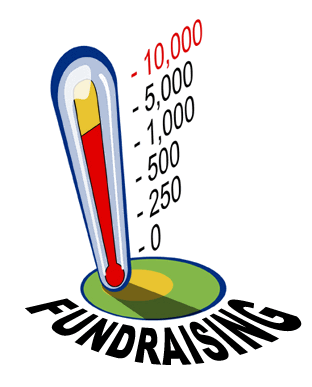
Track progress. Use key performance indicators (KPIs) to monitor your campaign's performance against your goals. Use a fundraising thermometer for online campaigns to visually display progress to motivate donors.
Phase 3: Post-campaign follow-up
Thank your donors. Immediately and personally thank every donor for their contribution. Send formal thank-you letters with tax receipts for contributions of $250 or more.
Evaluate your success. Hold a debriefing with your team to review what went well and what could be improved. Compare your results against your initial goals to gauge success.
Show impact. A few weeks after the campaign, send an update showing donors how their contributions were used. Use concrete numbers and stories to illustrate the impact.
Steward donor relationships. Stay in touch with your donors throughout the year by sharing news, reports, and invites to donor appreciation events. A strong stewardship plan encourages donors to give again.
Plan for the future. Apply the lessons learned from the campaign to improve your strategies and goals for your next fundraising cycle

Creative Charity Fundraising Ideas
To raise money creatively, charities can host unique events, partner with local businesses, or use online campaigns that tap into community and supporter enthusiasm. Ideas range from interactive virtual experiences to fun, themed in-person events that get people actively engaged with the cause.
Event-based ideas
"Chopped" pantry edition: Hold a cooking competition on Zoom where participants must create a dish using only ingredients found in their pantry. Charge an entry fee and have judges—or the audience—vote for the best creation.
Experience auction: Instead of just physical items, auction off unique experiences donated by local businesses or individuals. These can include a guided tour, cooking lessons with a local chef, or backstage access at a performance.
Murder mystery dinner party: Sell tickets for an interactive dinner event where guests work together to solve a fictional murder.
This is a fun and engaging way to fundraise that can also be done virtually.
Pet talent show: Encourage supporters to enter their pets in a virtual talent show. Charge a small entry fee and have the audience vote for their favorite pet's "talent" by donating online.
Virtual escape room: Teams pay to participate in a virtual escape room, with puzzles and clues that can be themed around your organization's mission. This is a great way to engage supporters from different locations.
Partnership and sales-based ideas
Branded merchandise: Partner with an online vendor to sell branded merchandise, such as t-shirts, hats, and stickers, featuring your charity's logo. You can set up a campaign to last for a set period to create urgency and excitement.
Branded beer or wine: Partner with a local brewery or winery to create a special, branded beverage, and have a portion of the sales go to your charity. This is a popular option in the Tampa Bay area, where craft breweries are prominent.
Community cookbook: Compile favorite recipes submitted by supporters, volunteers, and staff into a cookbook. You can sell the finished product online and at events.
Restaurant partnership night: Arrange for local restaurants to donate a percentage of their sales on a specific night to your cause. Promote the event to your supporters to encourage them to dine out for a good cause.
Used book sale: Collect donated books from the community and host a pop-up book sale. This can be organized in a public space, like a community center, or in partnership with a local bookstore.
Challenge and social media ideas
Social media "takeover": Have a local influencer or a passionate volunteer "take over" your charity's social media accounts for a day. The guest host can share their experience with your mission, answer questions, and encourage donations.
"Sleep-in-a-box" challenge: Ask supporters to spend a night sleeping in a cardboard box to raise money for a cause like homelessness. They can get friends and family to pledge donations for their participation.
Seasonal "a-thon": Organize a themed challenge like a winter "read-a-thon" for kids or a summer "hike-a-thon". Participants can track their progress and collect pledges online.
Unsubscribe challenge: Ask supporters to unsubscribe from a paid service they don't use often and donate that monthly amount to your charity instead. This is an innovative way to highlight the impact of recurring giving.

Sources for Charity Fundraising
Fundraising sources include online platforms for crowdfunding and peer-to-peer campaigns, traditional grant programs from foundations and corporations, and donations from individuals. Events, social media, and sales of goods are other common methods.
Online fundraising
Crowdfunding platforms: Sites like GoFundMe, Kickstarter, and Indiegogo allow individuals and organizations to raise money from a large number of people online. GoFundMe is popular for personal causes, while Kickstarter and Indiegogo are often used for creative and tech-related projects.
Peer-to-peer fundraising tools: These platforms help your most dedicated supporters raise money for your cause through their personal networks.
Platforms: CauseVox, Donately, Givebutter, and Qgiv offer tools for creating customizable peer-to-peer campaigns.
Social media integration: Many tools allow fundraisers to easily share personalized pages on social media, like Facebook.
Social media platforms: Nonprofits can use social media to reach donors directly.
Features: Facebook and Instagram have built-in donation buttons and stickers.
Engagement: Visual content on platforms like Instagram and YouTube is effective for storytelling, while LinkedIn is better for corporate donors.
Challenges: TikTok and X (formerly Twitter) are useful for running challenges and sharing quick updates.
Government grants: Federal, state, and local government agencies offer grants, often with detailed application and reporting requirements. They are typically for specific purposes that address public needs.
Foundation grants: Private, corporate, and family foundations give grants based on their specific priorities and interests, such as education, health, or the arts. Examples include the Bill & Melinda Gates Foundation, Ford Foundation, and Coca Cola Foundation.
Corporate grants: Some companies, like Walmart and Bank of America, give direct financial contributions or in-kind services to nonprofits as part of their corporate social responsibility efforts.
Technology grants: Companies like Amazon Web Services (AWS) provide grants for modernizing technology and infrastructure.
Corporate partnerships
Corporate sponsorships: Businesses provide funding for an event or project in exchange for brand recognition.
Workplace giving programs: Companies can set up programs for employees to make automatic charitable donations from their paychecks.
Matching gift programs: Many companies, such as Apple, will match the charitable donations their employees make, sometimes doubling or tripling the initial gift.
In-kind donations: Businesses provide non-monetary goods or services, such as free event space, printing, or accounting services.
Cause marketing: This strategy ties the sale of a company's product or service to a donation to a specific cause. For example, a company might pledge to donate a portion of sales to a charity.
Individual giving
Donations and major gifts: Individual donors are the largest source of charitable giving in the U.S. These contributions can come from single, major gifts or smaller, regular donations.
Planned gifts and bequests: These are donations made as part of a donor's financial or estate planning, such as leaving assets to an organization in a will.
Membership dues: Organizations can offer memberships with special benefits in exchange for recurring fees.
Special events and other methods
Fundraising events: These can include auctions, galas, bake sales, walkathons, and other in-person or virtual gatherings.
Selling goods and services: Some organizations generate revenue by selling products or services that align with their mission, such as apparel or workshops.
In-kind donations: Gifts of products (like food or medicine) or services that save the organization money on expenses.
Investment income: Well-established nonprofits may use investment income from endowments to fund their mission

Charity Fundraising Platforms
Choosing a charity fundraising platform depends on your organization's specific needs, including budget, campaign type, and required features. Options range from free all-in-one solutions to paid platforms with advanced tools for large-scale events.
All-in-one solutions
These platforms are designed to provide a complete suite of fundraising tools.
Givebutter: Known for its ease of use, this platform offers a free, all-in-one solution for fundraising campaigns, event ticketing, and auctions. It is primarily supported by optional tips from donors, with 95% of users covering the standard processing fees.
BetterWorld: This platform offers a wide range of fundraising methods for free, including auctions, crowdfunding, and event ticketing. The platform is donor-supported through optional contributions.
Mightycause: An all-in-one platform suitable for small to mid-size nonprofits. It offers tools for team fundraising, giving days, and year-round campaigns.
Crowdfunding platforms
Ideal for launching campaigns that rely on widespread social sharing.
GoFundMe: A widely recognized platform known for crowdfunding, it is available for both individuals and charities. Nonprofits can create customized pages and take advantage of GoFundMe's wide user base.
Fundly: This platform offers visually driven crowdfunding campaigns and integrates with Facebook to help organizers broadcast their campaigns to a wide audience.
Platforms with specialized features
These options are best if you are looking for specific functionality to run specialized campaigns.
Donorbox: This versatile platform offers AI-powered features, recurring donation options, and an "UltraSwift" checkout process to minimize donor drop-off. It also integrates easily into existing websites, including WordPress, Squarespace, and Wix.
Bonfire: Best for merchandise fundraising, this platform lets you design and sell custom apparel like t-shirts with no upfront costs. It handles printing and shipping, allowing you to focus on promotion.
OneCause: Designed for event-driven fundraising, OneCause provides tools for virtual, in-person, and hybrid events. Its features include mobile bidding for auctions, event ticketing, and peer-to-peer campaigns.
Funraise: For mid-to-large nonprofits that need high customization, Funraise offers a flexible platform with a drag-and-drop site builder, AI-powered tools, and a built-in CRM.
99Pledges: This platform is ideal for pledge-based events like walk-a-thons and read-a-thons, particularly for schools and youth groups. It features fast, free setup and allows participants to have their own fundraising pages.
Social media and payment tools
For those who want to leverage a pre-existing social network or simply accept payments.
Facebook Fundraisers: Allows individuals and nonprofits to create fundraisers directly on the platform and tap into a large community of users. Donations for U.S.-based nonprofits are handled exclusively by PayPal Giving Fund, with associated transaction fees.
PayPal Giving Fund: Serves as a straightforward payment processor for donations and can integrate with other platforms. It offers a secure and widely recognized way for nonprofits to accept one-time or recurring gifts.
How to choose the right platform
Before committing to a platform, consider these factors:
Cost: Compare platform fees, payment processing fees, and any monthly or yearly subscription costs. Some platforms are truly free, while others charge fees to the nonprofit, pass them on to donors, or require a paid plan for advanced features.
Campaign type: If you plan to run a specific type of campaign, such as a merchandise sale or auction, choose a platform that specializes in those features. For multiple types of campaigns, an all-in-one solution may be best.
Features: Assess your need for features like customizable donation pages, peer-to-peer capabilities, event management tools, donor management (CRM), and integrated marketing.
Ease of use: Some platforms offer a simple setup, while others have a steeper learning curve but provide more customization options. Consider your team's technical skills when making a decision.